Pages

Showing posts with label dog breeds. Show all posts

Sunday, June 12, 2011

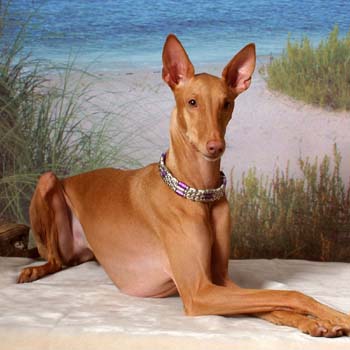
Pharaoh Hound Dog Description, History and Temperament


Description:

The Pharaoh Hound has a short smooth coat of a rich tan colour, which is not sufficient to protect them from cold weather. Standing some 21-25 inches high and weighing approximately 54-55 pounds, they're classed as a medium-sized dog. They are an elegant looking dog, with very distinctive ears and a long muscular neck. They are energetic and agile with a good turn of speed, also being fairly independent in nature. They have an intuitive intelligence, which can be seen in their stance. Although they are independent in nature, they mix well as a family pet, seeing the family as their group or pack. The engendered intelligence of this animal makes them respond well to training.

History.

The Pharaoh hound begins its history in ancient Egypt. Although there are myths and Legends surrounding the breed, mummified and skeletal remains have been found in Egyptian tombs that strongly resemble the modern Pharaoh. Some 3,000-4,000 years ago they were introduced to Malta by the Phoenician traders, who colonised the island. At some point the traders abandoned the islands leaving the dogs behind, where they continued to breed and forage for themselves for approximately 2000 years. This may explain how this dog so closely resembles its ancestors, as there were no other breeds of dog upon the island, at that time. Whereas in Egypt with the variety of dogs in the country this breed all but disappeared, thereby attributing them to Malta. Having been originally bred as Pharaohs hunt dogs, and subsequently left alone to fend for themselves for 2000 years, may explain why their hunting instinct is so deep and apparently inbred.

Temperament.


As mentioned the Pharaoh hound is an instinctive hunter, this has the implication that, unless they are introduced as a puppy to other household pets, they may view some of them as fare game, to be hunted. They are very active and require a good level of exercise. This is a breed which should be walked on a leash, and only allowed independent exercise in a well fenced area as, once they have the scent, they are very difficult to call off the hunt. Even after extensive training this instinct can still be a problem. They are independent in their own thinking and actions, but they do interact with families well and enjoy playing, but remember they may be stronger than they look. Care should be taken around small children as they may get knocked over in play, it will undoubtedly be an accident as, whilst these dogs are accomplished hunters, they are not malicious in nature.


Training

An independent-minded by trainable Pharaoh Hound requires positive training methods. This breed is sensitive, and will respond poorly when physical punishment is used. Training should start while they are young to get the best out of this hound. This breed can be stubborn, but it is important to always use positive reinforcement, rewarding their good deeds and ignoring the bad ones. Remember, this breed has been developed to take care of himself, so he tends to operate on his own. Being firm but gentle will make training easier for Pharaoh Hounds.


Care

This short coated breed is easy to groom. Basically, the Pharaoh Hound only requires a weekly rub with a rough cloth, oftentimes called a hound cloth. They won't even need that much combing. However, they do enjoy being rubbed with a brush, and massaged to remove dead hair monthly. This breed should be trimmed properly, and should never be done quickly. Often, these dogs are brought to the groomer or vet for a professional treatment.


Tuesday, June 7, 2011

Dutch Shepherd history and information


Dutch Shepherds have been distinguished from the other varieties of working line shepherds in a relatively short period of time, a little over a hundred years. Originally used by human shepherds to herd, guard and defend flocks of sheep on the flat fields of Holland, they were prized for their workability and guard drive.
The Dutch Shepherd dog is fairly rare in North America, and is also limited in their local country, Holland. This breed is greatly admired for their fast reflexes and capabilities.

The late nineteenth century brought a reduction in the amount of sheep herds in Holland and therefore a loss of work for shepherds and their Dutch Shepherd dogs alike. Interest started to develop in owning and showing these highly intelligent dogs and the Nederlandse Herdershonden Club (Dutch Shepherd Dog Club) was formed as a result. Early members included founders of the K.N.P.V.

Attention started to be paid toward creating standards for the breed, including color, coat length, bone density and size. Formal breeding practices evolved to produce dogs that met the criteria. "Undesirable" traits, especially pertaining to coloration, were bred out as much as possible. As a result, Dutch Shepherds became more common in appearance.

Traits that have always been a part of the Dutch Shepherds' genetic makeup include a high degree of intelligence, adaptability, courage and natural born guard drive. With the proper training foundation, they make excellent protection dogs. In fact, one of my clients insists that her Dutch Shepherds are better protectors than her human bodyguards.  Also great with children, they love to socialize and especially exercise with their handler. 
Versatile, beautiful and most of all protective, Dutch Shepherds have proven themselves to be among the best of the working line shepherds.

Temperament

The Dutch Shepherd is one of the most competent shepherd dogs there is, and does very well at jobs such as catch, obedience competitions, guard work, herding and field trailing. This breed is very fond of its territory and a very keen worker. These dogs are warm, content, clear-headed and very faithful to their families. Being friendly, affectionate, good-humoured and highly energetic these dogs are in general very happy and smart. The Dutch Shepherd can be good friends with children if they give them some time to be alone. These dogs will greet friend and family excitedly, but will b hostile toward unwanted visitors. This breed will get along with other animals, but also enjoys the company of their own kind. Owners will find these dogs to be clever, easy to train in obedience train and very keen on learning. The Dutch Shepherd makes excellent watch and guard dogs and is always alert.

Care

Both the long and short-haired Dutch Shepherd dogs are very high maintenance when it comes to grooming. They should be brushed often to remove any dead and loose hairs. The short-haired coats should be trimmed by professionals two times a year. It recommended that the surplus hair on the ears should be removed. The wire-haired variety should not be brushed ever, but they can be combed once in a while. This breed has an all-weather coat that should be bathed only when it is really necessary otherwise the natural oils on the skin will be removed.

Training

The Dutch Shepherd will need a dominant trainer but at the same time they also learn very quickly. It is important that their training sessions are varied; otherwise they will loose interest quickly. They do extremely well in obedience, police work, military work and guarding. The training environment for the Dutch Shepherd should be firm, fair and consistent.


Health problems

There are no recorded health issues for the Dutch Shepherd, and they will typically live for 12 to 14 years.