Pages

Showing posts with label dog problems. Show all posts

Sunday, June 12, 2011

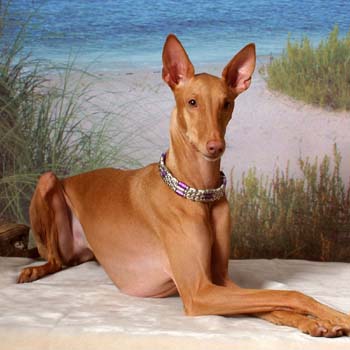
Pharaoh Hound Dog Description, History and Temperament


Description:

The Pharaoh Hound has a short smooth coat of a rich tan colour, which is not sufficient to protect them from cold weather. Standing some 21-25 inches high and weighing approximately 54-55 pounds, they're classed as a medium-sized dog. They are an elegant looking dog, with very distinctive ears and a long muscular neck. They are energetic and agile with a good turn of speed, also being fairly independent in nature. They have an intuitive intelligence, which can be seen in their stance. Although they are independent in nature, they mix well as a family pet, seeing the family as their group or pack. The engendered intelligence of this animal makes them respond well to training.

History.

The Pharaoh hound begins its history in ancient Egypt. Although there are myths and Legends surrounding the breed, mummified and skeletal remains have been found in Egyptian tombs that strongly resemble the modern Pharaoh. Some 3,000-4,000 years ago they were introduced to Malta by the Phoenician traders, who colonised the island. At some point the traders abandoned the islands leaving the dogs behind, where they continued to breed and forage for themselves for approximately 2000 years. This may explain how this dog so closely resembles its ancestors, as there were no other breeds of dog upon the island, at that time. Whereas in Egypt with the variety of dogs in the country this breed all but disappeared, thereby attributing them to Malta. Having been originally bred as Pharaohs hunt dogs, and subsequently left alone to fend for themselves for 2000 years, may explain why their hunting instinct is so deep and apparently inbred.

Temperament.


As mentioned the Pharaoh hound is an instinctive hunter, this has the implication that, unless they are introduced as a puppy to other household pets, they may view some of them as fare game, to be hunted. They are very active and require a good level of exercise. This is a breed which should be walked on a leash, and only allowed independent exercise in a well fenced area as, once they have the scent, they are very difficult to call off the hunt. Even after extensive training this instinct can still be a problem. They are independent in their own thinking and actions, but they do interact with families well and enjoy playing, but remember they may be stronger than they look. Care should be taken around small children as they may get knocked over in play, it will undoubtedly be an accident as, whilst these dogs are accomplished hunters, they are not malicious in nature.


Training

An independent-minded by trainable Pharaoh Hound requires positive training methods. This breed is sensitive, and will respond poorly when physical punishment is used. Training should start while they are young to get the best out of this hound. This breed can be stubborn, but it is important to always use positive reinforcement, rewarding their good deeds and ignoring the bad ones. Remember, this breed has been developed to take care of himself, so he tends to operate on his own. Being firm but gentle will make training easier for Pharaoh Hounds.


Care

This short coated breed is easy to groom. Basically, the Pharaoh Hound only requires a weekly rub with a rough cloth, oftentimes called a hound cloth. They won't even need that much combing. However, they do enjoy being rubbed with a brush, and massaged to remove dead hair monthly. This breed should be trimmed properly, and should never be done quickly. Often, these dogs are brought to the groomer or vet for a professional treatment.


Friday, June 10, 2011

Borzoi Dog Breed information


Description:


At first look, the Borzoi dog is similar to a greyhound. It has a narrow slightly domed head. The long muzzle is slightly arched. They have a level or scissor bite. They have a large nose, being black in colour. With dark eyes that have a slight slant. They spot their pray by sight rather than by the smell. Their ears are small and laid-back on the head. This dog has a long and slender neck. The chest is narrow and deep, the back line is arched slightly upwards. They have a low set tail with a sweeping curve. This is a large dog that is tall. This breed has silky, long, flat or wavy coat. Hair is to be found longer on the tail, neck and hindquarters. This breed can come in any colour combination, mostly all solid colours.


History:

This breed comes from Russia. For hundreds of years, belong to the Russian nobility. They were developed from the Russian wolfhounds and Arabian greyhound. This breed was called the Russian wolfhound, in America until 1936. When the name was changed, to what it is called today. This dog is a hunting dog. For hundreds of years this dog has been used for hunting, hare, Fox, and even wolves on the plains of Russia. It is now more a companion dog, and to match that, his temperament is more docile than its ancestors.


Temperament:

This breed is intelligent and very kind. This dog showing extreme loyalty, to their family. Showing great affection to people they know well. They are freethinking, less willing to satisfy their human owners than some breeds, in regard to obedience. Gentle and firm training works best with this breed, with clear rules of the home. This breed likes to keep themselves clean, and can appear catlike in grooming themselves. This dog rarely barks. Due to the extreme speed, and lack of any territorial instincts, it is a dog that is not safe off the lead. As with many breeds from the hunting dogs, this dog is not recommended to be left with any non-canine pets. Socialising this dog is a must with any cats or other pets, you have in the home from a young age is best. They are by nature sensitive, so will not like rough handling.


Health issues:

This breed is prone to bloat, so should have several meals throughout the day, fairly small in size. This breed needs high nutritional diets, particularly when they are growing.


Grooming:
 Although this breed has a long silky coat, it is easily groomed. This dog will require brushing regularly, and the occasional use of the dry shampoo. This is a seasonally heavy shedder.


Living conditions:
 With the right amount of exercise. This dog can live in an apartment. When outside, they need plenty of space to walk and run so a medium-sized garden is required. This dog is better living in the countryside, due to the fact it loves to run and is just not safety conscious.


Saturday, June 4, 2011

DOG FITNESS

 A FEW GOOD DOG-EXERCISE TIPS


Fetch is a fantastic way to give your dog aerobic exercise. Get an
old tennis racket to get some real distance on those tennis balls.
Jogging is another way to get canine hearts pumping. If you don't
jog and your dog is well-behaved on his leash, you may have a
friend or neighbor who'd welcome the company and the added
security. Swimming is a natural for retriever types, and if you're
lucky enough to be near an off-leash dog park, play with other dogs
is a first-rate exercise option.

Bicycling is another great exercise, and three products are on the
market designed to help you bicycle safely. They attach to the
bicycle and so allow you to keep both of your hands on the
handlebars - a much safer plan than holding onto a leash with one
hand and the bike with the other. The three products on the market
are the Springer, the Bicycle Dog Leash, and the K9 Cruiser.

Roadwork such as jogging or tagging alongside a bicycle can be good
for dogs, but remember to pace your dog properly: A brisk trot is
ideal.

Thinking of inventing an indoor dog exerciser? A treadmill for
dogs? Don't bother: They've been around for years. One such product
is The Trotter, a variable-speed treadmill used by show-dog
handlers to keep dogs in top condition for the ring. The Trotter
can be yours for a mere $1,000 or more so keep that high price in
mind.

Or you can just buy a regular treadmill down at your local Sears...
and it even comes with a warranty!

A few caveats about exercise, especially roadwork:
Have your veterinarian sign off on any exercise program, making
sure that your dog hasn't any joint problems that rule out any
particular kind of exercise. Make sure that you build up slowly,
especially if your dog is overweight. Let your dog set the pace,
and check the bottoms of his feet (the smooth parts are called
pads) often for tears or cuts.

Exercise when the weather is cool - dogs aren't as efficient at
lowering their body temperature as we are - carry water, always,
and know the signs of heat stress: glassy eyes, frantic panting. If
your dog gets in trouble, get him wet and call your veterinarian
immediately.

Do not force puppies to sustain a pounding pace, especially on
pavement, lest you injure their developing bones. That means no
jogging or bicycling until they're through adolescence - one year
old is a good ballpark figure, but check with your veterinarian.

Facts about rottweiler


The Rottweiler is a very special dog breed who has many incredible characteristics and personality traits. However these very same wonderful characteristics are what can get you into some decent trouble down the road if you don't undergo proper Rottweiler training. Before you start training you're Rottweiler, you have to understand their specific traits and personality, so that you can properly stimulate them.


- The Rottweiler is a very loyal dog that needs to always be close to their family. Like most German breeds, they seem to become closer to one particular member within the family more then others. The individual who becomes closest (the "master") to their Rottweiler should be the one that is engaged in training most heavily.

- Because the Rottweiler is so loyal and family oriented, it is always very eager to please its owner/s. This makes Rottweiler training far easier then many other breeds, and the owner can take advantage of this trait and increase the success rate of the training.

- The Rottweiler is a breed that can be very aggressive and dominate if it does not undergo proper Rottweiler training. Rottweiler's by nature are dominate dogs and need to be put in place (never by force) by a dominate and assertive owner. This breed is not recommended for timid individuals.

- The Rottweiler is very protective of its family and home, and it's because of this trait that if not trained properly it can become far too protective, aggressive and wary of any people other then family in its home or even on walks. It is very important that this breed be properly socialized at a young age and it taken out into public settings often. It should also be mentioned that if you don't usually have guests in your home and socialize your Rottweiler among them, they may be okay with outside the home, but within it.

Like any other breed of dog the Rottweiler needs to undergo specific Rottweiler training to ensure that it grows up to be a great family pet and well mannered dog. Too often throughout my career as a trainer and breeder have I seen many people try to train their Rottweiler's like their Labs, and of course pay the price in the long run. Make sure that you are armed with the proper knowledge and resources to make sure that this doesn't happen to you during you're Rottweiler training.